Your one stop for condo insurance.
Stop calling agent after agent for one quote each. One call, and a licensed agent shops your HO-6 with several insurance companies, A-rated options included, then lays the offers side by side. You pick.
You are in the right place. Keep reading for the answer, or call and let the shopping start now.
Illinois condo unit owners
Condo Insurance Illinois
The licensed agent behind this site compares Illinois HO-6 policies from several companies. The short answer: the master policy must insure the common elements and the units1, yet your board can pass its deductible to the owners involved in a loss2.
It can also require you to insure damage your unit causes a neighbor3. Build your HO-6 around those rules.
- One call, not ten
- Several companies shopped for you
- No obligation: a quote never binds
Compare my condo quotes
Several companies, side by side. You decide.
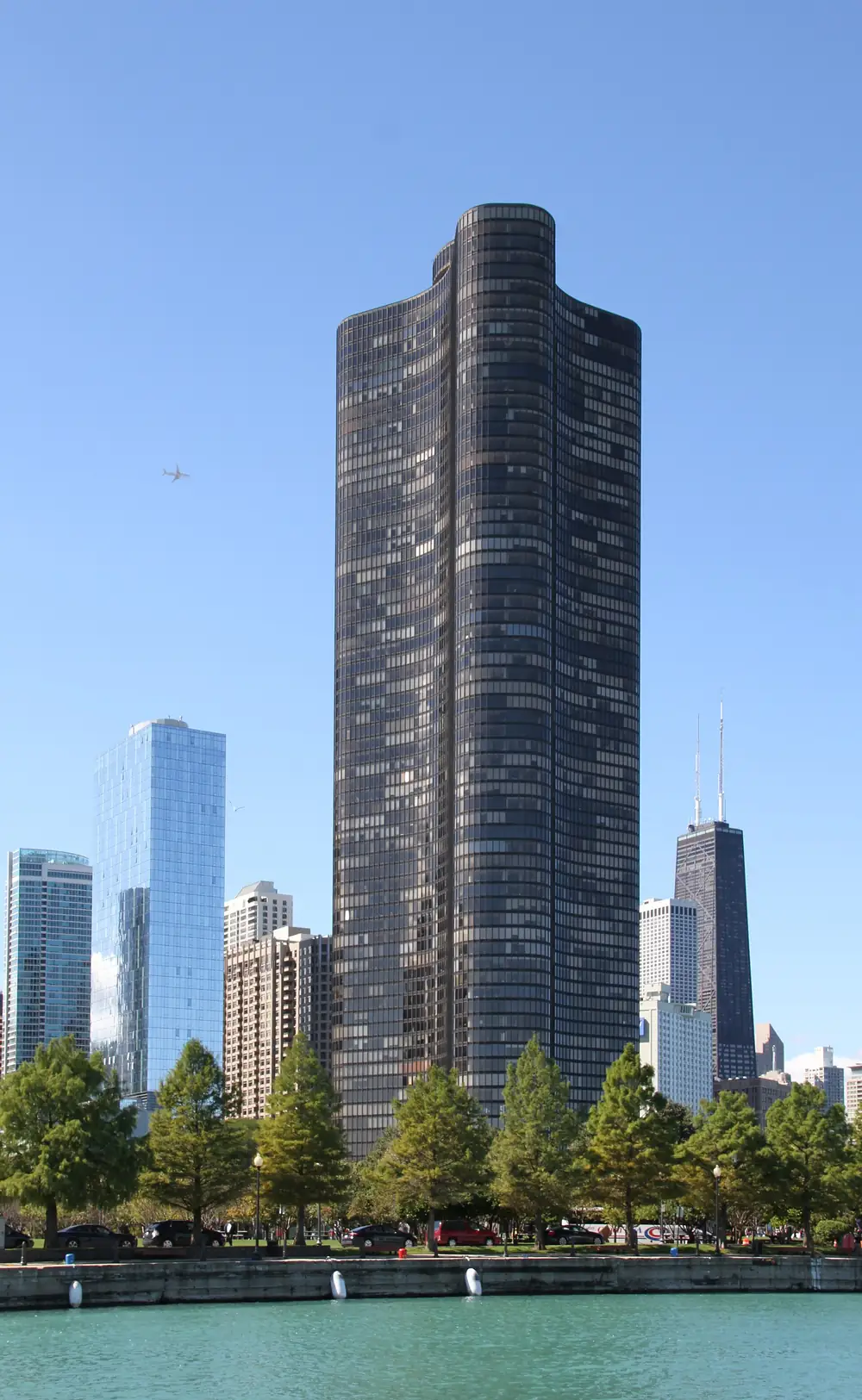
Lake Point Tower, a lakefront residential condominium high-rise near Navy Pier, Chicago. Photo: Tony Hisgett from Birmingham, UK, CC BY 2.0, via Wikimedia Commons.
Are your bare walls on the master policy?

Illinois puts bare walls, floors and ceilings on the association's policy unless your board opts out. That choice moves your HO-6 limit.
- Structure and units: the association's policy
- Bare walls: yours only if the board opts out
- Upgrades and belongings: yours
A policy issued or renewed to an association has to cover the common elements and the units, limited common elements included, against special form causes of loss, for no less than full insurable replacement cost minus deductibles, with building-code rebuild coverage built in1 (765 ILCS 605/12(a)(1)1).
Go deeper: the board's opt-out and what usually falls to you
The bare walls, floors and ceilings of your unit are on that policy unless the board decides otherwise1. Because the board can opt out, the line inside your unit varies by building, so get its decision in writing.
Even a policy that meets the floor has a deductible and stops somewhere inside your unit. Past that line is yours to insure.
What usually falls to your HO-6
- Anything the board chose to leave off the master policy, which can include the bare walls, floors and ceilings.
- Finishes and upgrades beyond what the master policy covers: flooring, cabinets, built-in appliances, fixtures.
- Your belongings, your liability inside the unit, and extra living costs if you have to move out during repairs.
The HO-6 insurance guide walks through each coverage part.
Condo insurance Illinois: the deductible your board passes on
Even when the master policy pays, your board can send its deductible to the owners involved. Know which path it uses.
- Three paths, chosen by your board
- Your unit can be the one billed
- Ask which path your building uses
For a claim on a unit or the common elements, the board picks one of three options (765 ILCS 605/12(c)2):
- Pay the deductible as a common expense, shared by all owners2.
- After notice and a chance for a hearing, charge it to the owners responsible for the damage or to the unit where the loss began2.
- Require the owners of the damaged units to pay it2.
Your declaration, bylaws and board rules show which path applies. Ask before you set your own limits.
Go deeper: wind, hail and your own HO-6 deductible
Your HO-6 may carry one deductible for all perils or a separate one for wind or hail. Read the deductible lines on your declarations page at each renewal.
If your loan follows Fannie Mae's guide, a lender following it keeps your deductible at or below $2,500 or 5% of your coverage amount, whichever is more4.
Your board can make you insure the neighbors' damage
An Illinois board rule can require coverage for damage your unit causes another unit, even when nobody was careless.
- Set by declaration, bylaws or board rule
- Applies with or without negligence
- Reaches the neighbor's deductible and finishes
Through the declaration and bylaws or a board rule, the board may require each owner to insure personal liability and compensatory (not consequential) damage to another unit, whether the owner or a guest was negligent or the damage simply started in the owner's unit3 (765 ILCS 605/12(h)3).
Go deeper: what that required liability has to include
That liability includes the other owner's deductible, damage left uninsured, and their paint and decorating, floor and wall coverings, trim, appliances and furnishings3.
Ask the board whether your building has such a rule, then make sure the liability part of your policy is written to meet it.
Declined elsewhere? The FAIR Plan still writes HO-6
Illinois has a fallback for condo owners the market turns away, but its policy pays differently, so treat it as a bridge.
- HO-6 unit owner policies on its list
- Actual cash value, named perils
- Ask for fresh quotes at each renewal
The Illinois FAIR Plan lists HO-6 unit owner policies, and its producer summary describes the condo form as actual cash value on broad named perils5.
What that means: actual cash value subtracts depreciation, and a named perils form covers only the causes it lists.
Go deeper: how a standard-market HO-6 can differ
Standard-market policies can often add replacement cost and broader coverage by endorsement. Treat the plan as a fallback, and have your unit requoted in the standard market at each renewal.
Claim stalled? The state hotline can step in
The Illinois Department of Insurance runs a consumer hotline for claims and complaints that go sideways.
- Have the carrier's decision in hand
- Keep policy and claim numbers close
- Call the Consumer Assistance Hotline
If a claim stalls or a decision looks wrong, call the Illinois Department of Insurance Consumer Assistance Hotline at 866-445-53646.
See which policy answers when tornado winds hit
Federal storm records log tornado events across Illinois. Knowing which policy answers for wind damage keeps your claim moving.
- Roof and windows: usually the master policy
- The board's deductible choice still applies
- Your HO-6 covers what is inside
Wind damage to a roof or windows is usually a master policy claim, yet its deductible can still reach you through the board's choice above. Your HO-6 picks up what the master policy leaves inside your unit.
Five Illinois gaps to check before renewal

Each of these can turn a covered loss into an out-of-pocket bill. Swipe through and check them against your board's rules.
- Leaks from upstairs
- Deductibles and assessments
- Units left empty
Go deeper: the rules and coverage behind each gap
The upstairs owner's coverage
If the board requires owners to carry liability coverage for damage to other units, the upstairs owner is expected to insure damage that came from their unit, including your deductible and your coverings and furnishings3. If the board has no such rule, fault matters more. See water damage from the unit above for the steps.
Coverage letters A and C in detail
Your Coverage A picks up whatever is permanently installed in the unit and left off the association's policy8. Built-in appliances usually land in Coverage A under the standard HO-6 form that many carriers write on; confirm it in your own policy9. Coverage C handles your belongings, such as furniture, clothing, computers and TVs, if they are stolen or a covered loss damages or destroys them10.
The contents calculator helps with Coverage C, and how much condo insurance covers Coverage A.
Loss assessment coverage and the lender floor
Loss assessment coverage may help when the association assesses owners for a loss the community suffers, provided your own policy covers the cause11. Check your policy for any cap on a deductible passed to you. Where a Fannie Mae loan meets a master deductible set per unit, your limit must reach that per-unit deductible, or more if restoring the uncovered interior costs more12. More on loss assessment coverage.
Empty units and your insurance
Tell the company if the unit will sit empty or be rented; many policies limit coverage for unoccupied homes, so check your policy.
Reserves and the next assessment
Reserves decide how often a repair turns into a special assessment. Read the reserve and assessment sections of your declaration and bylaws, and ask the board for this year's budget, how much sits in reserve, any pending engineering or inspection report and any assessments being planned.
Compare several companies against your board's rules
An Illinois HO-6 has to fit your board's deductible path and liability rule. Several companies side by side show which ones do.
- Identical limits, several companies
- Ask which discounts apply; they vary
- You choose; a quote binds nothing
An agent who writes for a single company can show you that company's HO-6. Matching limits across several companies shows whether one of them handles your Illinois unit in a different way.
Many owners have never had a walls-in amount, a loss assessment limit or a deductible choice looked at. Discounts or credits: ask each company, since availability varies by company and state; the quote shows whether any apply.
Go deeper: how an Illinois comparison runs
You send the details. A licensed agent compares HO-6 options from several companies against what your master policy leaves to you, and you decide what to buy.
Keep in mind that a quote does not bind coverage; coverage begins only when a policy is issued.
Tick off your papers and start the comparison
Starting from your real documents means the options match your building's rules, not a guess about them.
- Tap each item as you find it
- Partial is fine to start
- Add any board rule on owner coverage
For an Illinois unit, add any board rule on owner coverage and the master policy's deductible. Improvements you or a prior owner made, such as flooring, cabinets and appliances, count too.
Illinois unit owners can ask for quotes here. Licensing details by state sit in the agent disclosure.
Illinois condo owner questions
Who pays when a pipe in the unit upstairs floods my Illinois condo?
The master policy handles the structure it insures, and the board decides who pays its deductible, which can be the owner whose unit the leak came from. Your finishes, upgrades and belongings go through your HO-6. If your board requires owners to carry liability for damage to other units, the upstairs owner's policy may pay your deductible and damage your insurance does not cover.
Rain got into my Illinois condo through the building and damaged the floor. Whose policy pays?
Start with the master policy, which covers the units on special form causes of loss and includes the bare floor unless your board decided otherwise1. Finished flooring beyond that may be yours under Coverage A. Whether rain entry is covered depends on each policy's wording, so check both and report it to the association first.
How much loss assessment coverage should I carry in an Illinois high-rise?
Start with the master policy deductible and how your board passes it on. If the board can charge the whole deductible to one unit, ask how your policy treats a deductible passed to you, since many forms cap what loss assessment coverage pays toward one. Then leave room for a share of a loss that runs past the master policy's limits.
Should an Illinois townhouse owner buy an HO-6 or an HO-3?
It turns on who insures the structure. If your townhouses are a condominium under the Act, the association's policy must include the units1, so an HO-6 usually fits. If your association is not a condominium and your declaration makes you insure the building, look at an HO-3. Compare the two on HO-6 vs HO-3.
What does a buyer's lender need to see on a small association's master policy?
Under Fannie Mae's guide, the buyer must carry a unit owners policy when part of the unit interior or improvements is missing from the master policy, or when that policy carries a per-unit deductible13. Ask the association's agent for a certificate that states the valuation basis, the covered perils and the deductible.
Is condo insurance required in Illinois?
Your board can require you to carry liability coverage for damage to other units3. Your lender may require a policy too, as the answer above explains. Either way, the master policy is not written for your belongings, so an HO-6 is what protects them.
Before you renew, make one call.
A licensed agent compares several companies on the same limits. Asking changes nothing on your policy, and a quote never binds you.