Your one stop for condo insurance.
Stop calling agent after agent for one quote each. One call, and a licensed agent shops your HO-6 with several insurance companies, A-rated options included, then lays the offers side by side. You pick.
You are in the right place. Keep reading for the answer, or call and let the shopping start now.
New Jersey condo unit owners
Condo Insurance New Jersey
A licensed agent working through this site can help you find, in one conversation, where your association's required insurance ends and your HO-6 has to start. The Condominium Act makes the association insure every common element and every structural part of the property1.
Past that line, your finishes, furniture and liability ride on your own policy. See how several companies would cover them before you renew.
- One call, not ten
- Several companies shopped for you
- No obligation: a quote never binds
Compare my condo quotes
Several companies, side by side. You decide.
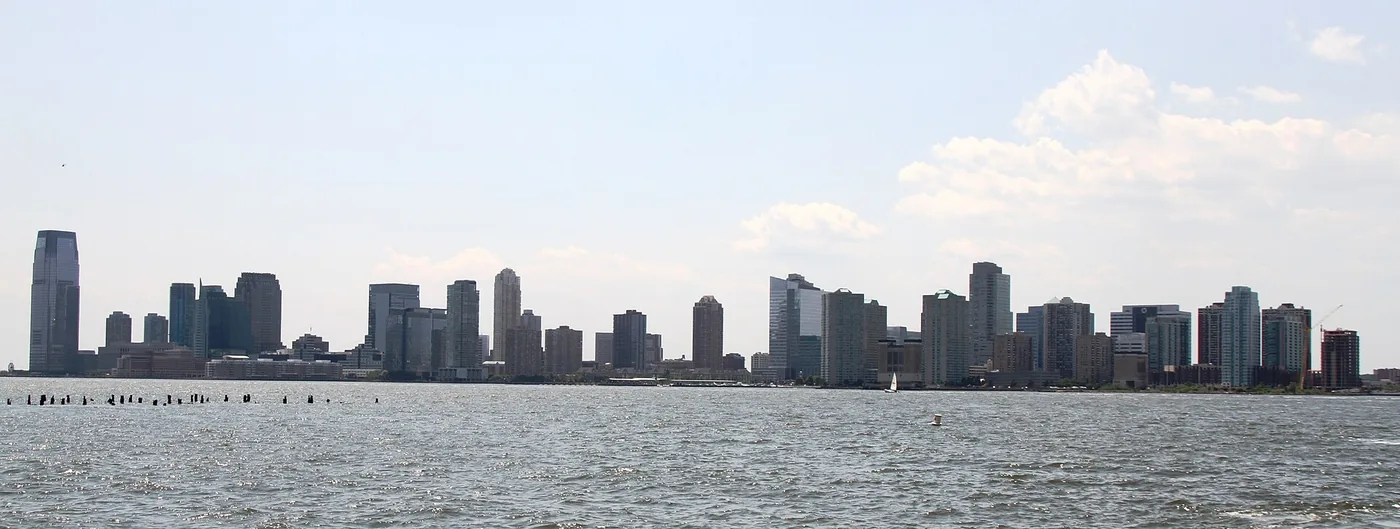
Jersey City Hudson River waterfront skyline of residential and office towers. Photo: Bjoertvedt, CC BY-SA 3.0, via Wikimedia Commons.
See exactly where the association's policy stops

New Jersey names what the association must insure. What your documents leave past that line is your policy's job.
- Structure and common elements: the association
- Finishes and upgrades: check your documents
- You already pay for the master policy
The association has to carry broad-form fire and extended coverage insurance on every common element and every structural part of the condominium, and put the proceeds toward restoring them when restoration is required1 (N.J.S.A. 46:8B-14(d)1).
The cost is a common expense1, so every owner pays a share of the master policy through the monthly charges.
Go deeper: why your cabinets and floors are not settled by the statute
That section names the common elements and the structural parts. It does not settle whether your cabinets, flooring, fixtures or upgrades are in the association's policy.
Your master deed, your bylaws and the master policy itself are where to look. Get the insurance section of both documents and the policy certificate before you set your own limits.
Condo insurance New Jersey: your hurricane deductible limits
New Jersey limits when a hurricane deductible kicks in and how large it gets. Both shape your storm claim check.
- Named hurricanes with measured hurricane-force winds only
- A size cap set by regulation
- Compare this deductible on every quote
When it applies: only for a hurricane the National Weather Service has named, once it has measured sustained winds of 74 mph or more somewhere in New Jersey2 (N.J.A.C. 11:2-42.7 and Exhibit D2). Those winds do not have to reach your building2.
How large it can be: a carrier, or the FAIR Plan, can file to impose a hurricane deductible of up to 5 percent, or to offer an optional one of up to 10 percent3 (N.J.A.C. 11:2-42.9(a)-(b)3).
Go deeper: where these deductibles are allowed, and what never triggers one
Those deductibles are allowed in a listed set of ZIP codes, and elsewhere only with DOBI approval3.
A named storm that never produces a measured hurricane-force wind in the state does not trigger this deductible. Your declarations page shows which deductible you carry, so hold it next to the price when you compare quotes.
Read the inspection report before it reaches your budget

The structural inspection law sets when your building gets checked, and what the inspector finds can reach your wallet.
- A deadline for the first inspection
- Repeat inspections on a schedule
- Repairs usually come from reserves or assessments
The first inspection is due by whichever comes first: 15 years after the certificate of occupancy, or 60 days after damage to the primary load-bearing system is observed4 (N.J.S.A. 52:27D-132.44).
Ask your board three things: whether the law covers your building, when it was last inspected, and what the report found.
Go deeper: the full inspection schedule, and why insurance rarely pays for repairs
- A building whose certificate of occupancy was 15 or more years old when the law took effect had 2 years to inspect4.
- The next inspection comes no more than 10 years after the first, or within 60 days of observed damage if sooner, and later ones no more than 5 years apart4.
Repairs a report calls for are usually paid from reserves or a special assessment, not from insurance. So the board's answer tells you what to budget for.
Turned down? NJIUA may have no unit form
If other companies decline you, New Jersey's residual market may not offer a unit-owner form at all. Plan around that early.
- No HO-6 on NJIUA's list
- Its dwelling program is for private dwellings
- Ask the plan directly before relying on it
NJIUA, New Jersey's FAIR Plan, lists no HO-6 or condominium unit-owner form. Its dwelling program covers 1 to 4 family private dwellings and personal property incidental to a dwelling, and other real property goes to its commercial program5.
Its materials leave open whether a single condo unit qualifies. If you are turned down, ask NJIUA before you count on it, and compare several companies first.
Claim stuck? New Jersey's DOBI hotline takes the call
When a carrier's claim decision looks wrong, New Jersey's insurance department will take your call.
- Get the carrier's decision on paper
- Have your policy and claim numbers ready
- Then call DOBI
The Department of Banking and Insurance (DOBI) takes calls at 609-292-7272 or on its Consumer Hotline, 1-800-446-7467, 8:30 am to 5:00 pm, Monday through Friday6.
Check five gaps before a claim finds them
Five spots where a New Jersey claim can come up short. Each card takes seconds to check against your policy.
- Leaks from upstairs
- Deductibles passed to you
- Assessments insurance may not pay
Water from the unit above
A leak from upstairs can touch three policies: the association's for structure, yours for finishes and belongings, and your neighbor's. Flood is a separate policy.
Coverage A or C
The less your master deed puts in the association's policy, the more Coverage A you need. Belongings sit in Coverage C.
The master policy deductible
Look in your bylaws for whether the association can charge its deductible to the owner whose unit a loss started in.
Vacant or seasonal units
Away for the season? Know your hurricane deductible before you leave, and tell the carrier if the unit sits empty or is rented.
Special assessments
An assessment for repairs an inspection turned up is usually treated as maintenance, so loss assessment coverage is unlikely to pay it. Check your policy.
Go deeper: liability, loss of use, lender rules and assessments
When the water leaves your unit
If the leak starts in your unit, personal liability (Coverage E) can pay to defend you against certain lawsuits, and it covers you if you are found legally responsible for damage to a neighbor's property7. If covered damage makes your unit uninhabitable, loss of use (Coverage D) pays the extra living costs while you are out8. See water damage from the unit above for the claim steps.
Fannie Mae rules for your HO-6
If your mortgage follows Fannie Mae's guide, a unit owners policy becomes required once the master policy leaves any interior or improvements uncovered, or uses a per-unit deductible9, with a limit at least equal to the greater of the cost to restore that uncovered interior or the per-unit deductible10. The same guide caps your own deductible at the greater of 5% of your coverage amount or $2,50011.
The hurricane deductible for a seasonal unit
The hurricane trigger turns on the Weather Service measuring hurricane-force winds in the state from a named hurricane, not on what reached your unit2. If the unit sits empty in winter, keep the heat on, and check your policy for vacancy and rental wording.
Loss assessment coverage for covered losses
Loss assessment coverage may help pay your share of a special assessment for a loss the community suffers, such as storm damage beyond the master policy limits, as long as your own policy covers the cause12. Our loss assessment coverage page has more.
Size Coverage A to your master deed
Set Coverage A too low and your finishes may not be fully rebuilt. Tap a policy type to see your layers.
- A: installed property the association skips
- C: the belongings you own
- Built-in appliances usually land in A
Coverage A is for property permanently installed in your unit that the association's policy leaves out13. Coverage C is for belongings like furniture, clothes, computers and TVs when a covered loss damages, destroys or takes them14.
Go deeper: appliances and the standard HO-6 form
Many carriers use the standard HO-6 form, and under it built-in appliances usually belong to Coverage A; read your own policy to be sure15. See how an HO-6 policy works.
Line up several companies, hurricane deductible included
Seeing identical limits and deductibles from several companies at once is how you learn whether another company treats your unit differently.
- One quote shows one company's view
- Ask which discounts or credits apply
- No quote binds coverage
A single-company agent can offer only that company's HO-6. Comparing several on the same limits, with the hurricane deductible shown on each option, makes the differences visible.
Many unit owners have never had their walls-in limit, their loss assessment amount or their deductible reviewed. For discounts, put the question to each company, since availability varies by company and state; any that apply to your condo show on the quote.
Go deeper: what happens after you ask
The agent lines up your unit with several companies, fits the coverage to what your master deed and bylaws leave to you, and shows the hurricane deductible on each option. The choice is yours.
No quote binds coverage; your policy starts only once it is issued.
Four papers that sharpen your New Jersey quote
Starting from your real documents means every option matches what your master deed actually leaves to you.
- Four items, all easy to request
- Any one of them gets things going
- The master certificate shows its deductible
- Your declarations page, if you already carry an HO-6.
- The association's master policy certificate, with its deductible, from the board or property manager.
- The insurance sections of your master deed and bylaws.
- A room-by-room list of upgrades. For belongings, try the contents calculator.
New Jersey unit owners can ask for quotes here; for licensing, see the agent disclosure.
New Jersey condo insurance questions
Is condo insurance mandatory in New Jersey?
The Condominium Act puts the insurance duty on the association: common elements and structural portions1. A requirement for you usually comes from your bylaws or your lender. Under Fannie Mae's guide, a unit owners policy is required when the master policy leaves out interior or improvements, or has a per-unit deductible9.
What does a New Jersey condo master policy have to cover?
Fire and other-casualty insurance on the common elements and the structural parts of the condominium, with the proceeds used to restore them1. Anything beyond that depends on your master deed, your bylaws and the wording of the policy itself, so ask the board for all three.
How big can a hurricane deductible be in New Jersey?
Up to 5 percent when the deductible is mandatory and up to 10 percent when it is optional, in the listed ZIP codes or elsewhere with DOBI approval3. Your declarations page shows the one you carry, and each quote should show it too.
Does the hurricane deductible apply to every named storm?
No. It applies only when the Weather Service measures sustained winds of 74 mph or more in New Jersey from a hurricane it has named2. A named storm that never produces those measured winds in the state does not trigger it; check your policy for any other wind deductible.
Can I get a condo unit policy from the New Jersey FAIR Plan?
NJIUA lists no HO-6 or condo unit-owner form5, and it does not say whether a condo unit qualifies for its dwelling program. Ask the plan directly, and have several companies compared before you rely on it.
Before you renew, make one call.
A licensed agent compares several companies on the same limits. Asking changes nothing on your policy, and a quote never binds you.