Your one stop for condo insurance.
Stop calling agent after agent for one quote each. One call, and a licensed agent shops your HO-6 with several insurance companies, A-rated options included, then lays the offers side by side. You pick.
You are in the right place. Keep reading for the answer, or call and let the shopping start now.
Florida condo unit owners
Condo Insurance Florida
The licensed agent behind this site compares HO-6 coverage from several companies for Florida condo owners, and here is the short answer: Florida's condo act tells the association's master policy to leave out most of what is inside your unit, and hands that list to you.
That list decides your HO-6: how much coverage you need, which hurricane deductible fits, and where an assessment can reach you.
- One call, not ten
- Several companies shopped for you
- No obligation: a quote never binds
Compare my condo quotes
Several companies, side by side. You decide.
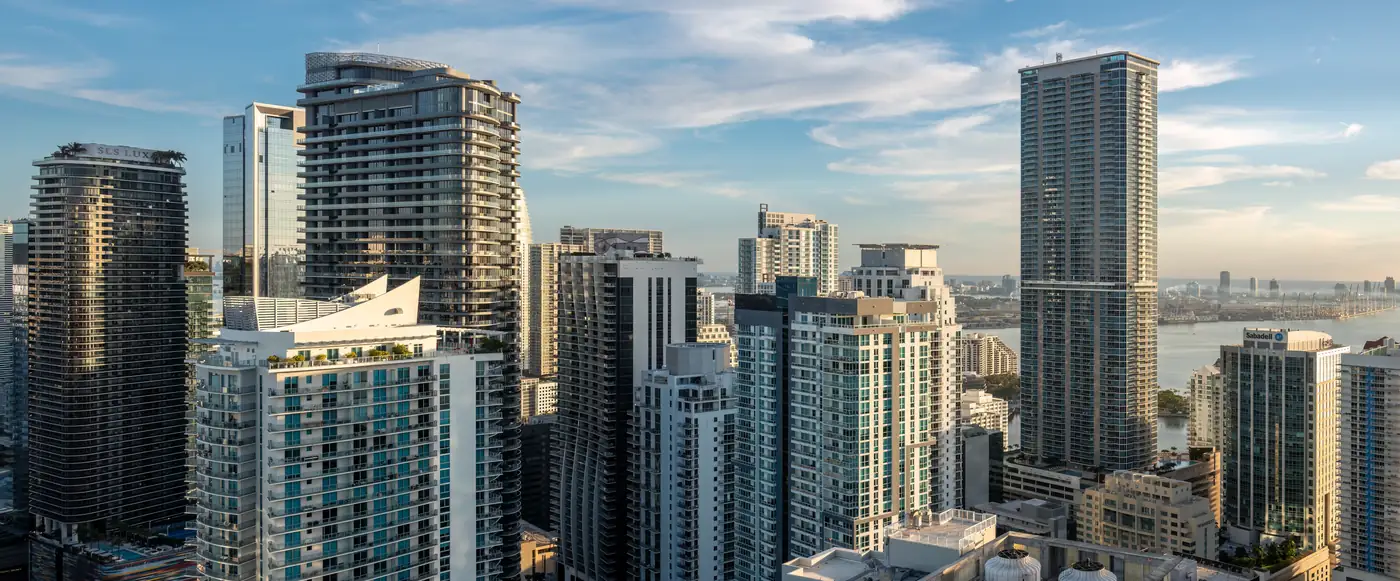
Residential high-rise towers in the Brickell neighborhood of Miami, with Biscayne Bay in the background. Photo: Rhododendrites, CC BY-SA 4.0, via Wikimedia Commons.
Know exactly what Florida leaves you to insure
Florida law names the items the master policy must skip. Every one of them is yours to insure.
- The list is written into the statute
- Coverings, fixtures, appliances, cabinets, counters
- Upgrades by you or a past owner count too
The rule: the association's policy must leave out your belongings plus, where they serve only your unit, its built-in cabinets, countertops, appliances, water heaters and water filters, electrical fixtures, window treatments and the coverings on its floors, walls and ceilings, replacements included1 (Fla. Stat. § 718.111(11)(f)3.1).
The same law makes those items, and any insurance on them, the unit owner's responsibility2 (Fla. Stat. § 718.111(11)(f)3., (g)2).
Kitchen
Cabinets, counters, appliances, flooring, light fixtures.
Bathroom
Vanity, counters, tile, wall coverings, fixtures.
Floors, walls and ceilings
Carpet, wood, tile, paint and other coverings.
Fixtures and window treatments
Electrical fixtures, blinds, drapes, shades.
Water heater and utility closet
Water heater, water filter and appliances that serve only your unit.
Condo balcony and storage
Your things in a limited common element, such as patio furniture.
Tap "Bare walls" below for a rough picture; your declaration settles the edges.
Go deeper: three details that change who pays
Serving only your unit. A water heater or fixture that serves more than one unit is not on your list. Ask how the association treats shared equipment.
Replacements count. The list covers replacements. If you or a prior owner put in new cabinets, stone counters or better flooring, the upgrade is yours to insure, at what it would cost to replace.
Items not on the list. The list names coverings, fixtures and equipment, not everything in a unit. For anything it leaves out, read the master policy summary and your declaration, and ask the manager how past claims were handled.
With no policy on those items, a loss to them has no insurance behind it.
Responsibility is not a mandate. The act assigns the responsibility; it does not, by itself, order you to buy a policy. What it does settle is that the master policy is not where those items are insured.
Condo insurance Florida: build your HO-6 from the law's list
Each HO-6 part maps to a piece of the Florida split. Set limits from the list, not a round number.
- Coverage A: the listed items plus upgrades
- Coverage C: everything you own inside
- A mortgage often brings an HO-6 requirement
Many owners carry a Coverage A figure nobody ever checked against the cabinets, counters and floors in the unit. Price out the list, add your upgrades, and that is your starting point.
Then set Coverage C from an inventory of what you own. Tap a letter to see what each part pays for.
The how much condo insurance guide walks through both limits, and the HO-6 insurance guide explains each coverage part.
Go deeper: where the letter definitions come from, and what your lender expects
The plain-language letter definitions paraphrase a condo form summary published in New Jersey's insurance rules. They explain the letters; they are not Florida law, and your own policy's wording controls.
Coverage A takes over for permanently installed property in your unit that the association's coverage does not already include3. In Florida, that starts with the statute's list of coverings, fixtures, appliances, cabinets and countertops.
If you have a mortgage, your lender has its own view. Fannie Mae's guide has the borrower hold a unit owners policy in either of two cases: the master policy leaves out some part of the unit interior or unit improvements, or it carries a per-unit deductible8.
Because Florida's master policy must exclude the interior items on the list, a Florida unit financed under that guide will usually meet the first test.
Loss assessment: Florida's minimum is a floor, not a target
Every Florida unit-owner policy must carry some loss assessment coverage. Whether that is enough depends on your building, not the statute.
- The law sets a minimum, not your need
- One limit covers every assessment from one loss
- Only causes your policy covers count
The Florida minimum: at least $2,000 of property loss assessment coverage, one limit for every assessment from the same direct loss, provided your policy covers that type of loss9 (Fla. Stat. § 627.714(1)9).
Your real share of a building loss depends on the size of the loss, the master policy's limits and deductible, and your ownership percentage. Many owners keep the minimum simply because nobody asked about those three things.
The loss assessment coverage guide shows the math.
Go deeper: the three parts of the rule that matter when you pick a limit
It is a minimum. The statute sets the least a policy may carry. It says nothing about what your share of a large building loss could be.
It is per loss, across every assessment. The limit covers all assessments from the same direct loss. If the board levies in stages after one storm, those stages share one limit.
The cause has to be one your policy covers. An assessment for a loss your HO-6 would not cover falls outside this statutory minimum.
So treat the statutory amount as a starting line. Ask for the master policy's deductible and your ownership share, then decide whether a higher limit makes sense.
See your hurricane deductible in dollars before you choose
Florida insurers must offer set hurricane deductible choices. Seeing them in dollars lets you pick one you could pay.
- A flat option stays put as limits rise
- Percentage options grow with your coverage
- Your declarations page has the final word
Before issuing a personal lines residential policy, a Florida insurer must offer a flat $500 hurricane deductible plus percentage choices of 2, 5 and 10 percent of the policy dwelling limits10, subject to exceptions in the same subsection (Fla. Stat. § 627.701(3)(a)10).
One catch for condo owners: the percentages apply to policy dwelling limits, a phrase the statute does not define for condominium unit owner policies11. So run the tool on Coverage A alone, then on A plus C, and see the range.
Florida hurricane deductible math for a condo unit (HO-6)
This applies the options in Florida's hurricane deductible statute for personal lines residential policies. Ask your insurer whether it applies them to your HO-6. Enter your own limits. The tool multiplies; it does not quote or price anything.
Why the choice: the statute states its percentages as a share of "policy dwelling limits" and does not define that phrase for a unit-owner policy11. Your insurer's form decides. Check your declarations page.
| Option in the statute10 | Your hurricane deductible |
|---|
These are the options the statute tells insurers to offer, subject to its exceptions. They are not a complete list of what an insurer may write: the statute carries exceptions this tool does not model, and an insurer does not have to offer a percentage option that works out below the flat option. Your declarations page shows the deductible that applies to you.
The tool is math, not a quote. It multiplies the limits you enter by the statute's options. It does not price a policy or tell you what any insurer will offer.
Go deeper: how the options play out on an HO-6, and a lender's cap
Ask your insurer to confirm that your HO-6 is written under this rule and which options it offered you. The statute adds a proviso: an insurer does not have to offer a percentage option that works out below the flat dollar option.
- A flat option stays the same no matter how high you set your limits.
- A percentage option grows with the base. If you raise Coverage A to insure the statute's list properly, a percentage deductible tied to Coverage A rises with it.
- On a small base, some percentages drop out. A unit with a modest Coverage A may see fewer percentage choices.
- The list is what must be offered, not a full menu. The statute carries exceptions, and the options on your declarations page are the ones that apply to you.
Coverage A or A plus C: the base the statute leaves open
On a house policy the dwelling limit is easy to find. On an HO-6 it is less clear, because the unit-owner form splits your property between Coverage A for the unit and Coverage C for your belongings.
Your insurer's form decides which base it uses, and your declarations page shows the hurricane deductible in dollars. If the tool and your declarations page differ, go by the declarations page, and read it at every renewal.
Your hurricane deductible and a lender's cap
If your loan follows Fannie Mae's guide, the lender limits your own deductible: $2,500 or 5% of the unit policy coverage amount, whichever is greater, across all required perils12. Ask your lender or servicer whether that cap reaches your hurricane deductible, and check any percentage choice against it.
SIRS reserves: the budget line owners cannot vote away
Florida bars a vote to skip or cut reserves for structural study items. That shapes your dues and assessments, not your HO-6.
- Reserve money for study items stays in the budget
- It cannot be moved to other costs
- A shortfall can still reach owners
For budgets adopted on or after Dec 31, 2024, owners of an association that must have a structural integrity reserve study (SIRS) may not vote for no or reduced reserves for the study's items, or use those reserves for other purposes13 (Fla. Stat. § 718.112(2)(f)2.b., 3.13).
Buying or renewing? Ask the board or manager whether your association must have a SIRS, and ask for the most recent study and the current budget.
Go deeper: what the reserve rule means for your money and your coverage
The statute has a narrow exception for a multicondominium that uses an alternative funding method approved by the state's condominium division.
- Reserve contributions are part of the budget. If your association must have a SIRS, the reserve line for those items cannot be voted to zero. That money reaches you through your regular assessments.
- The reserves stay put. Money collected for SIRS items cannot be moved to cover other costs.
- A shortfall can still reach you. If reserves are behind, closing the gap costs owners money, through a higher budget or a special assessment. Ask the board which it plans.
- Insurance does not fund reserves. Loss assessment coverage responds to an assessment from a covered direct loss. Reserve funding and planned repairs are not a loss, so your HO-6 generally does not pay them.
Whether your association must have a SIRS depends on the building.
Turned down elsewhere? Citizens is Florida's residual market
If private companies will not write your unit, the state's residual market may. Check two things before you count on it.
- It is written for owners who live in the unit
- Unit value, with contents, has a ceiling
- A wind-only version exists too
Citizens lists condominium unit owner policies, HO-6 and a wind-only HW-6, for owners who live in the unit. Its unit-owner coverage reaches certain interior features, personal property, additional living expenses and liability, but not the building exterior14.
The value test: a unit whose combined dwelling and contents replacement cost is $700,000 or more is not eligible, though in counties the Office of Insurance Regulation finds lack reasonable competition, a unit under $1 million is eligible15 (Fla. Stat. § 627.351(6)(a)3.15).
Go deeper: what this means if you are turned down
- Citizens is the state's residual market, and its own rules decide who qualifies.
- The owner-occupancy description matters. If you rent the unit out or use it only part of the year, ask how Citizens treats that before you count on it.
- The value test uses dwelling plus contents together, so add Coverage A and Coverage C when you check it.
- The HW-6 is the wind-only version of the unit-owner policy.
Claim stalled? Call Florida's DFS insurance helpline
When your company will not give a straight answer, the state's consumer helpline is the next call. Bring the right paperwork.
- Get your insurer's answer in writing first
- Have policy and claim numbers ready
- Keep a dated timeline of every contact
The Florida Department of Financial Services insurance consumer helpline: 1-877-MY-FL-CFO (1-877-693-5236)16. From outside Florida: (850) 413-308916.
Before you call, gather your policy number, claim number, the adjuster's name, and a short written timeline of what happened and when.
Close these five Florida condo gaps before a claim
Five places a Florida claim can come up short. Check each now, while you can still change your coverage.
- Leaks from upstairs
- Limits that the list alone can use up
- Assessments after a building loss
Water in your unit right now? Tap where it started.
Go deeper: what to do in each of the five cases
After a leak from upstairs. Anything Florida's list leaves out is settled by the master policy and your declaration. Your Coverage D can help if the unit is unlivable during repairs. If the neighbor caused the leak, their liability coverage may come into play, and your insurer may pursue them after paying you.
- Stop the water if you can, and tell the manager in writing right away.
- Photograph the damage before anything is moved or removed.
- Open a claim on your own policy; do not wait for the neighbor's company.
- Read the water wording in your policy. Forms treat a sudden burst differently from a slow leak. Flood is a separate policy.
The water damage from the unit above guide lays out each step.
Sorting A and C. Your furniture, clothing and electronics are Coverage C. A freestanding appliance can land on either side depending on the form, so ask. Sort your items with the contents calculator.
The master deductible. A hurricane deductible on a whole building can be large, and a special assessment is one way it can reach you. Whether your loss assessment coverage pays toward your share of the association's deductible depends on your policy form, so ask before you rely on it. If the master policy has a per-unit deductible, a lender following Fannie Mae's guide expects your unit owners coverage to be at least that deductible18.
Empty or seasonal units. Say plainly how the unit is used when you ask for a quote, shut off the water before a long absence, and arrange for someone to check the unit and secure it before a storm.
Special assessments. When the community suffers a loss and the association charges members a special assessment for it, such as after wind damage beyond the master policy limits, loss assessment coverage may help pay; when your own policy covers the cause, it covers the assessment for that cause as well19. Apply that test to any Florida assessment, and ask the board about planned or pending assessments before you close.
One company's quote shows one company's answer
Companies can treat the same Florida unit differently. Side by side, on the same limits, you see it.
- Same limits and hurricane deductible on each
- Ask which discounts or credits apply
- A quote binds nothing; you decide
A quote from one company shows that company's terms and nothing else. Lining up several on the same limits is how you learn whether another one sees your unit differently.
Many owners have never had their Coverage A amount, loss assessment limit or hurricane deductible choice reviewed. Every comparison here looks at all three.
Discounts: what exists and who qualifies varies by company and state, so ask each company. Your quote lists any that apply.
Florida condo and co-op unit owners can request quotes through this site; the agent holds a Florida insurance license. Asking for a quote binds nothing; coverage begins only when a policy is issued.
Go deeper: how a Florida comparison works, step by step
- You share your unit details, your current declarations page and the association's master policy summary.
- The agent reviews what Florida's list and your master policy leave to you.
- HO-6 options from multiple carriers are lined up with the same limits and deductibles, including the hurricane deductible choices.
- You see the differences side by side, including any discounts or credits a company applied.
- You decide which, if any, to take.
To understand what moves a quote up or down, see condo insurance cost factors.
Gather these and your Florida comparison moves fast
A few papers let an agent map what Florida's list leaves you and compare every company on equal terms.
- Some of it may already be in your email
- Any one item is enough to start
- Nothing here commits you to anything
Florida extras for your HO-6 quote
- The hurricane deductible line from your current declarations page.
- The master policy certificate with its deductibles, including whether wind is covered on the building.
- What each upgrade would cost to replace: flooring, cabinets, countertops, appliances and fixtures.
Prefer to write it all down first? Send a quote request.
Florida condo owner questions
Is it mandatory to have condo insurance in Florida?
Florida's condo act makes the listed interior items, and any insurance on them, the unit owner's responsibility Fla. Stat. § 718.111(11)(f)3., (g)2. That is not the same as ordering you to buy a policy. A lender usually requires one: under Fannie Mae's guide, a borrower needs one when the master policy leaves out any interior part or has a per-unit deductible8. Your declaration may too.
If I paid cash for a Florida condo, can the association make me carry an HO-6?
Your association's documents answer this. Read the insurance section of the declaration and bylaws. Even without a requirement, the condo act leaves your coverings, fixtures, appliances, cabinets, countertops and belongings to you. Without a policy, replacing them after a loss comes out of your pocket, and you would have no liability or loss assessment coverage.
Does a Florida condo owner need an HO-3 or an HO-6?
A condo unit owner usually carries an HO-6, because the association insures the building and you insure what the master policy leaves out. The legal form of ownership matters more than the look of the building. If you own the structure outright, an HO-3 may fit instead. Read your deed and declaration, and see HO-6 vs HO-3.
Which policy should I buy for a Florida condo?
Start with an HO-6. Set Coverage A to replace the items Florida's list leaves to you, upgrades included, and Coverage C from an inventory of your belongings. Carry at least the state's $2,000 loss assessment minimum9, and consider more. Confirm whether wind is included, and choose a hurricane deductible you could pay.
What should I carry when I buy an upper-floor unit in a Florida high-rise?
The floor does not change Florida's list. The listed interior items plus your belongings are yours, so you need an HO-6 with enough Coverage A and C. Leaks from above and assessments after a building loss are worth planning for, so check the water wording and your loss assessment limit. Ask for the master policy summary before closing.
How do condo insurance quotes work in Florida?
You share your unit details, your declarations page and the association's master policy summary. The agent compares HO-6 options from multiple carriers with the same limits and deductibles side by side, including the hurricane deductible choices. You decide which, if any, to take. A quote does not bind coverage. Send a quote request to start.
Does a large Florida high-rise association carry windstorm coverage on the building?
Do not assume either way. Ask the manager for the current master policy certificate or summary; it shows whether windstorm is included, the hurricane deductible and the limits. Your HO-6 does not insure the building structure, and Citizens' unit-owner coverage does not reach the building exterior. The master policy's wind terms tell you how exposed you are to an assessment.
Can a Florida condo association drop windstorm coverage and rely on special assessments instead?
Check your association's paperwork: the master policy summary shows whether wind is covered, and the declaration shows what the board must carry. Ask the board in writing. If building wind coverage is reduced, a storm loss may be paid through assessments, and loss assessment coverage helps only when your policy covers the cause. Citizens lists a wind-only HW-6 for owner-occupants.
How does a percentage hurricane deductible on the master policy affect Florida unit owners?
A percentage deductible on a whole building can be a large sum. When a hurricane loss falls inside it, the association may assess owners for their shares. Whether your loss assessment coverage pays toward it depends on your form. Ask for the master policy's hurricane deductible and your ownership percentage, then size your limit with the loss assessment guide.
What hurricane deductible options must a Florida insurer offer on my HO-6?
For personal lines residential policies, the insurer must offer a $500 option and options of 2, 5 and 10 percent of the policy dwelling limits10, subject to exceptions Fla. Stat. § 627.701(3)(a)10. Ask your insurer to confirm your HO-6 falls under the rule. The statute does not define that base for unit-owner policies, so ask whether it means Coverage A alone or A plus C.
My uninsured upstairs neighbor's pipe leaked into my Florida unit. What pays?
Your own HO-6 is the policy for covered damage to your side of Florida's list, such as ceiling coverings, flooring and cabinets, plus your belongings, minus your deductible. Items outside the list are the master policy's question. If the neighbor was at fault, your insurer may try to recover from them. Report the leak in writing, photograph everything, and open your claim right away.
Can I file a claim directly on my Florida association's master policy?
The master policy insures the association, so the association usually reports and handles claims on it. Tell the manager about the damage in writing, ask them to report it, and keep copies. For items on Florida's list and your belongings, open a claim on your own HO-6. If it stalls, the DFS helpline at 1-877-693-523616 can help.
Does Citizens write condo insurance in Florida?
Yes, for owner-occupants. Florida's residual market offers an HO-6 and a wind-only HW-6 to condo owners who live in the unit 14. A unit is not eligible if its combined dwelling and contents replacement cost is $700,000 or more15, with a higher limit in counties the state finds lack reasonable competition. Treat it as the fallback when standard carriers decline.
Does my Florida HO-6 cover my appliances, water heater and cabinets?
Those items are on Florida's list, so the master policy must leave them out and they are yours to insure Fla. Stat. § 718.111(11)(f)3.1. Your HO-6 covers them if the cause is covered and your limit is high enough. The standard HO-6 form many carriers use usually puts built-ins under Coverage A; check your policy17. Include them when you set Coverage A.
Who can I call about a Florida condo insurance complaint?
Before you renew, make one call.
A licensed agent compares several companies on the same limits. Asking changes nothing on your policy, and a quote never binds you.