Your one stop for condo insurance.
Stop calling agent after agent for one quote each. One call, and a licensed agent shops your HO-6 with several insurance companies, A-rated options included, then lays the offers side by side. You pick.
You are in the right place. Keep reading for the answer, or call and let the shopping start now.
North Carolina condo unit owners
Condo Insurance North Carolina
A licensed insurance agent working through this site compares HO-6 quotes from several companies for North Carolina unit owners. The short answer under the current Condominium Act: the association's policy must include the units where reasonably available, but need not include improvements and betterments owners install1.
So your upgrades and belongings usually fall to you, and so can a deductible your declaration passes along. On the coast, check your named storm deductible first.
- One call, not ten
- Several companies shopped for you
- No obligation: a quote never binds
Compare my condo quotes
Several companies, side by side. You decide.
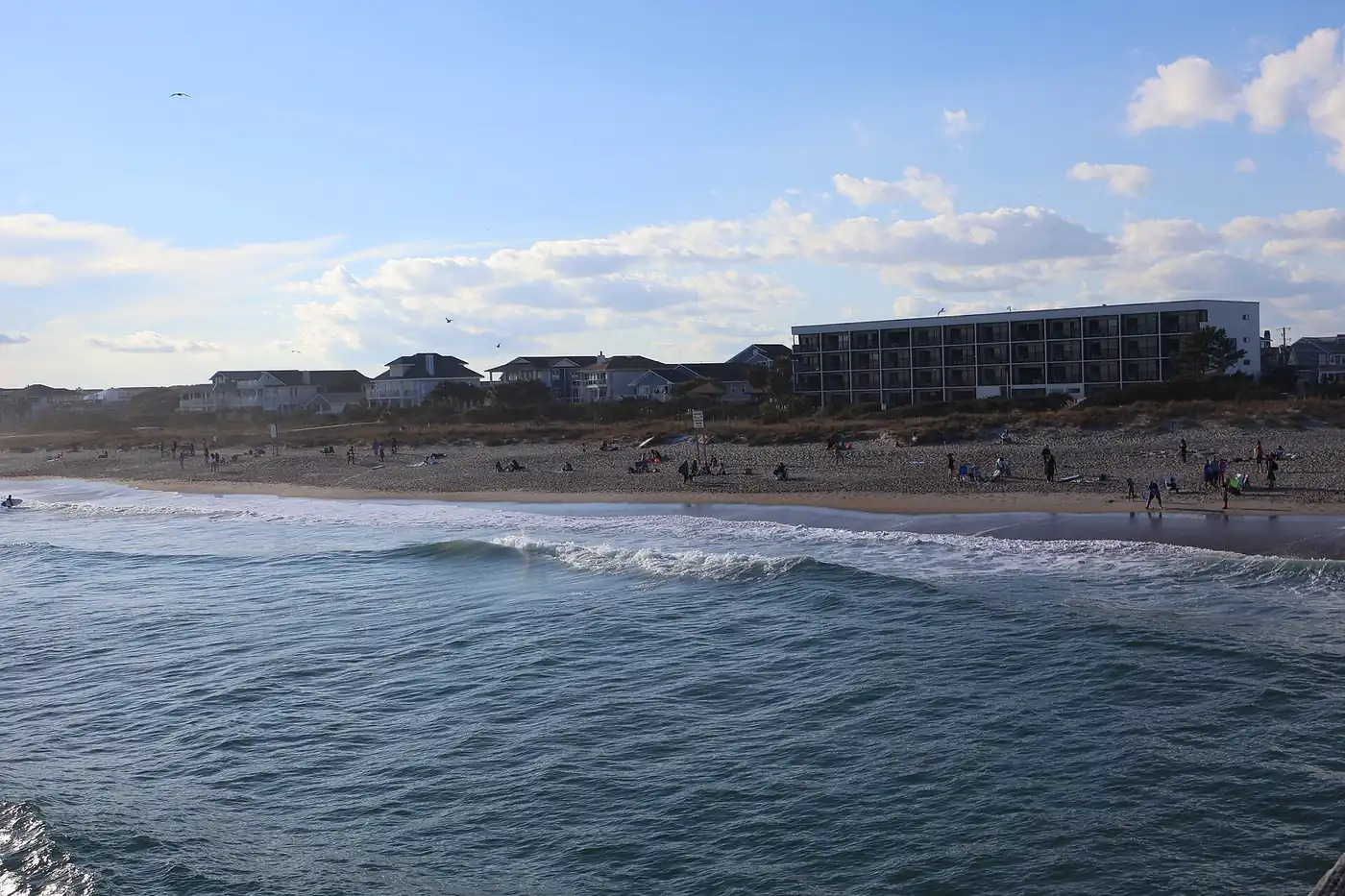
Oceanfront mid-rise building and beach houses at Wrightsville Beach, NC. Photo: DiscoA340, CC BY-SA 4.0, via Wikimedia Commons.
Condo Insurance North Carolina: who insures your upgrades

Under the current Act, the association's policy generally covers the unit as built; your upgrades usually fall to you.
- New floors, cabinets, a remodeled bath: usually yours
- Your declaration draws the exact line
- Older condos follow a different act
In a building where units stack above and below each other, N.C. Gen. Stat. § 47C-3-113(b)1 sets the split.
The association's side stops at what owners added. Those upgrades usually go under Coverage A of your unit-owner policy. Price them before you pick a limit.
Go deeper: condos created before the current Act
Condos created before the current Condominium Act
Check the date your condominium was created. Condominiums created on or before October 1, 1986 stay under the older Unit Ownership Act, the current Act's insurance section is not one of the provisions that reach them, and the older Act has its own insurance provision2 (N.C. Gen. Stat. §§ 47C-1-102; 47A-242).
In an older building, the units and betterments rule above may not apply. The declaration and the older Act decide what the association insures.
Either way, where the unit ends and your upgrades begin is set by the declaration and the master policy wording. Read both before you choose a limit.
Know your named storm deductible before the season starts
Your storm deductible decides what you pay yourself on a wind claim. Find it now, not after the storm.
- Many policies carry a separate storm deductible
- The Coastal Pool has a statutory floor
- Your lender may cap how high you go
Open your declarations page. Many HO-6 policies list a separate deductible for wind, hail or named storms, often a percentage of a coverage limit rather than a flat dollar figure.
The policy wording, often an endorsement, says when it kicks in. Many owners have never had that choice reviewed since they bought.
Go deeper: the Pool's floor and your lender's ceiling
The Coastal Pool's named storm deductible floor
Under N.C. Gen. Stat. § 58-45-45(a2)3, the Coastal Property Insurance Pool must offer a 1% named storm wind and hail deductible on all its policies, and may not offer one below 1% of insured value3.
That rule is written for the Pool. For a private company's HO-6, read that policy's own named storm terms.
Lender limits on your HO-6 deductible
If your mortgage follows Fannie Mae's guide, the deductible on your unit owners policy can be no more than the greater of 5% of the policy's coverage amount or $2,500, for all required perils4. Ask your lender before you raise it.
Ask about reserves before an assessment finds you
Thin reserves can turn a repair into a special assessment. Three questions to the board tell you where you stand.
- Ask for the budget and reserve figures
- Ask about the last structural inspection
- Then set your loss assessment limit
Reserves decide how often a repair becomes a bill split among owners. Ask the association for its current budget and reserve figures.
Ask the board whether the building has had a recent structural or engineering inspection. Then read the declaration and bylaws on how repairs are funded, and set your loss assessment limit with that in mind.
Turned down on the coast? The Coastal Pool writes HO-6
If private companies pass on your coastal unit, the state's residual market plan is the next place to ask.
- Writes the HO 00 06 unit-owners form
- Homeowner program: your principal residence only
- Rentals and second homes: ask what else fits
The Coastal Pool writes the HO 00 06 unit-owners form, but its homeowner program requires an owner-occupied principal residence, lived in 75% of the year or nine months5.
A beach unit you rent out or use as a second home does not fit that program. If the Pool will not take your unit, ask what other options exist before you let coverage lapse.
Go deeper: the Pool's wind-only form
The Pool's manual also lists the HW 00 06 form in its windstorm and hail program5. The Pool sets its own eligibility and terms, so compare any Pool offer line by line with a private one.
Claim stalled? Call the state's consumer helpline
When a claim stalls or a renewal surprises you, the Department of Insurance has a toll-free helpline.
- Consumer Services Division, toll-free
- Have your policy and claim numbers ready
- Keep every letter the insurer sent
The Department of Insurance's Consumer Services Division answers on 855-408-12126.
Before you dial, put your policy number, your claim number and any insurer letters in front of you. It makes the call shorter.
Tropical storm reports: why your storm terms matter here
The counter shows how often tropical storm reports were logged in North Carolina. That is reason enough to read your storm terms.
- Each record is a county or zone report
- Roof damage usually starts on the association's side
- Water inside can reach your upgrades
Each NCEI record is a county or zone report, not a separate storm.
Wind damage to roofs and windows usually starts with the association's policy. Rain that follows it inside can reach your upgrades and belongings, and that is where your own deductible and named storm terms apply. Flood is a separate policy.
Five gaps to check before a North Carolina claim
Each gap is a spot where a claim pays less than owners expect. Swipe through and check yours.
- A leak from upstairs can split two ways
- Built-ins and belongings sit on different lines
- How you use the unit changes the form
Go deeper: the fine print behind each gap
When water makes the condo unlivable
If covered damage makes the unit unlivable and you have to move out for a while, Coverage D pays the extra living costs above your normal ones11. Your declaration may also say who pays the master deductible when the leak starts in a neighbor's unit. More: water damage from the unit above.
Built-in appliances and your coverage
On the standard HO-6 form many carriers use, built-in appliances usually fall under Coverage A; check your policy12. Sort your items with the contents calculator, or read how a unit-owner form differs from a house form.
Matching the master policy deductible
If your lender follows Fannie Mae and the master policy has a per-unit deductible, your unit owners policy must carry at least the greater of what it takes to restore the uncovered interior and improvements, or the master policy's per-unit deductible13.
Seasonal condo units and the Coastal Pool
At the Coastal Pool, the HO-6 program is limited to a principal residence you live in, as described above. Whatever the use, the application should describe it plainly.
What loss assessment coverage leaves out
A bill for upkeep or thin reserves, with no covered loss behind it, is usually not something this coverage pays; check your policy. See loss assessment coverage.
One company's quote is only one answer for your unit
Companies can weigh the same coastal condo differently. Seeing several side by side, on the same limits, is how you find out.
- Same limits and deductibles on every quote
- Ask which discounts or credits apply
- Get your storm deductible choice reviewed
If your policy came through an agent who writes for one company, you saw one company's answer. It may be a fine answer. You just have nothing to hold it against.
Discounts and credits differ by company: protective devices, a claim-free history or combining policies are common questions. Ask each company; availability varies, and a quote shows what applies.
Asking for a comparison changes nothing on your current policy.
Get North Carolina quotes lined up in one conversation

Bring a few papers. The agent lines up several companies on your limits, and you make the call.
- Named storm deductible compared on each option
- A quote does not bind coverage
- Keep your policy until the new one is issued
The agent reads your declaration and the association's master policy, then compares unit-owner coverage from several companies. You weigh the options and choose.
Add the date your condominium was created. Unit owners in North Carolina can ask for quotes through this site; license details sit in the agent disclosure.
Go deeper: what moves a quote and how much to carry
Read the factors that move an HO-6 quote and how much coverage to carry. Or send a quote request now.
North Carolina condo owner questions
Is condo insurance required in North Carolina?
The requirement usually comes from your lender or your declaration. Under Fannie Mae's guide, you must carry a unit owners policy when the master policy leaves out any part of the unit interior or improvements, or when it has a per-unit deductible14. Read the insurance section of your declaration or bylaws as well.
How is a leak split between the master policy and my own condo policy?
In a stacked building, the association policy must include the units where reasonably available, but not improvements and betterments owners installed1. Your HO-6 picks up those upgrades and your belongings, and depending on the form it may help with a deductible the declaration lets the association charge you.
Does the Condominium Act's insurance rule apply to my older condo?
Not if it was created on or before the cutoff. Condominiums created on or before October 1, 1986 remain under the Unit Ownership Act2, so check your declaration's date and its insurance terms before you set your own limits.
What can a coastal association do when its master policy is hard to place?
One place to ask is the Coastal Pool, whose manual lists a CP 00 17 condominium association commercial form5. The Pool sets its own eligibility and terms. Owners should then compare their HO-6 and loss assessment limits with the new master terms.
Does the Coastal Pool's minimum named storm deductible apply to my private HO-6?
Not by its terms. That minimum is written for the Pool's own policies3. For a private carrier's policy, the named storm deductible and trigger on your declarations page and in the policy wording are what count.
Before you renew, make one call.
A licensed agent compares several companies on the same limits. Asking changes nothing on your policy, and a quote never binds you.