Your one stop for condo insurance.
Stop calling agent after agent for one quote each. One call, and a licensed agent shops your HO-6 with several insurance companies, A-rated options included, then lays the offers side by side. You pick.
You are in the right place. Keep reading for the answer, or call and let the shopping start now.
For realtors and loan officers
Condo Insurance for Realtors and Lenders
The licensed agent behind this site helps realtors and loan officers get a condo buyer's HO-6 sized and ready before closing, built around the master policy, its per-unit deductible and the lender's written rule.
Below: what the buyer's policy has to answer for, what to request from the association and when, a referral form and a one-page checklist you can print.
- One call, not ten
- Several companies shopped for you
- No obligation: a quote never binds
Compare my condo quotes
Several companies, side by side. You decide.
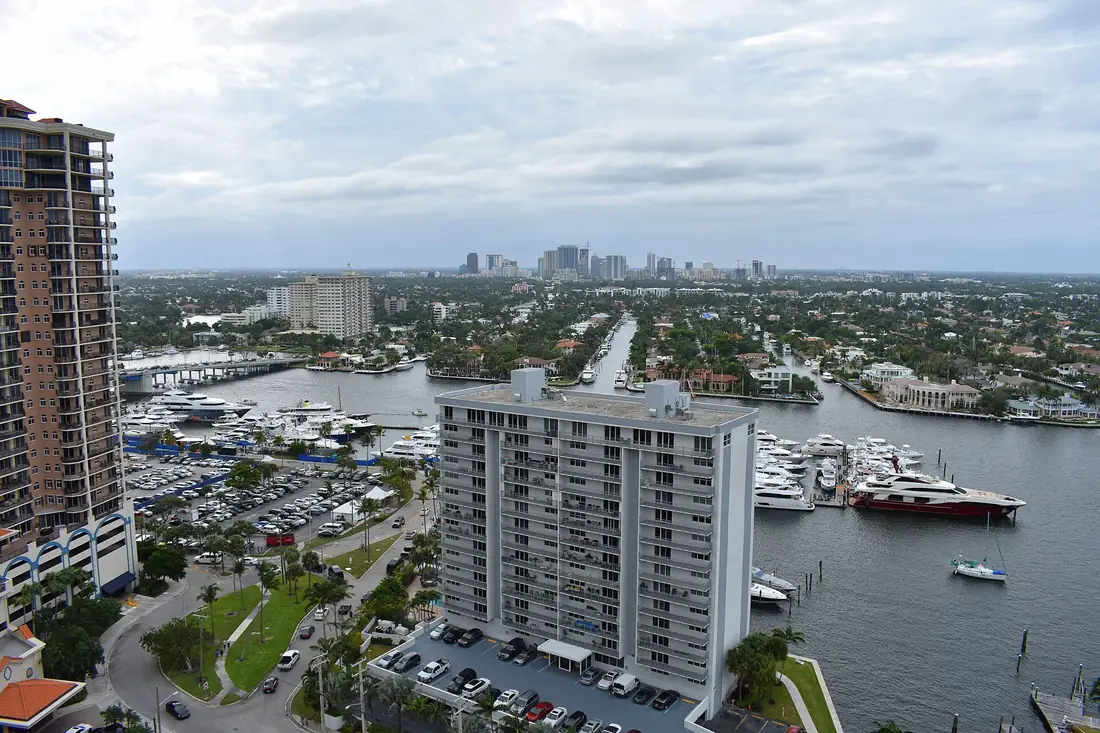
Waterfront residential high-rises and marina along the Intracoastal Waterway in Fort Lauderdale, with the downtown skyline in the distance. Photo: Tamanoeconomico, CC BY-SA 4.0, via Wikimedia Commons.
Pin down the master policy type before the buyer shops
The master policy type sets how much walls-in coverage the buyer needs, and the lender will look for it.
- Bare walls leaves the interior to the buyer
- All-in can still skip upgrades
- Get the type in writing early
Walls-in coverage (Coverage A on the HO-6) insures the part of the unit the master policy does not. Until someone reads the association's policy, nobody knows how big that part is.
One email to the manager for the master policy declarations settles it, and it keeps the buyer's quote from being redone late in escrow.
Go deeper: how the master policy labels change the buyer's walls-in number
Bare walls generally leaves floors, cabinets, fixtures and finishes to the unit owner. All-in generally covers the original interior, sometimes including improvements. All-in excluding improvements covers the original build but not later upgrades.
The labels are shorthand. The master policy wording and the condo declaration control, so read both before the buyer picks a limit.
Upgrades the seller made to the condo
When the master policy leaves out improvements, the buyer usually inherits the seller's tile, cabinets and built-ins as walls-in exposure. List them during the showing or inspection so the limit counts them. The HO-6 insurance guide covers each coverage letter, and the HO-6 policy form page walks through the form itself.
Size the HO-6 to the master policy deductible
A per-unit master deductible can land on the buyer after a loss, so the HO-6 has to be ready to answer for it.
- Find the deductible on the master declarations
- Note any separate peril deductible
- Match the buyer's limits to it
Some master policies apply the deductible to each damaged unit instead of the building as a whole. When that happens, the unit owner often pays that amount before the master policy responds.
The buyer's HO-6 can answer for it through walls-in coverage or loss assessment, depending on the form. That is a sizing decision to make before closing, not after a claim.
Go deeper: where the deductible hides and how to read it
- On the master policy declarations or certificate. Look for the all-perils deductible and any separate deductible for wind, named storms or water.
- In the bylaws or declaration. The insurance section often says who pays the deductible: the association, all owners, or the owner of the unit where the damage started.
- In the resale package. Some associations summarize the insurance there. Ask for the policy pages anyway; a summary can leave out a separate deductible.
For the full sizing walk-through, send the buyer to how much condo insurance to carry.
Protect the buyer from a special assessment bill
Loss assessment coverage can pay the buyer's share when the association bills owners for a covered loss.
- Often the tool for a deductible assessment
- Limits vary by form and company
- Size it to the buyer's share
When a covered loss to shared property costs more than the master policy pays, or falls inside its deductible, the association can pass the gap to owners. The buyer's loss assessment limit decides how much of that bill the HO-6 can take on.
In Florida, a unit-owner policy has to include at least $2,000 of loss assessment coverage for all assessments from one direct loss, when the policy covers that type of loss1. See the Florida page.
Go deeper: why the default loss assessment limit may fall short
A buyer's share of a master deductible can run well past a starting limit. Multiply the master deductible by the unit's percentage interest from the declaration, then compare it with the limit on the quote.
Whether loss assessment pays a deductible assessment depends on the form wording, so check the policy. The loss assessment coverage guide has a calculator for the buyer's share.
Meet the Fannie Mae HO-6 rules the first time
On a loan sold under Fannie Mae's guide, the HO-6 has a trigger, a minimum and a deductible ceiling.
- When a unit owners policy is required
- How much coverage it needs
- How high its deductible can go
When it is required. The borrower has to carry a unit owners policy when any part of the unit interior or its improvements is left out of the master policy, or when the master policy has a per-unit deductible2 (Fannie Mae Selling Guide B7-3-042).
How much. Coverage has to reach the larger of two figures: what it takes to bring the interior and improvements the master policy skips back to their pre-loss condition, and the master policy's per-unit deductible, if one applies3.
Deductible ceiling. The HO-6 deductible can be no higher than the greater of 5% of the unit policy's coverage amount or $2,500, for all required perils4.
Go deeper: how to use these rules on a live file
The guide talks about the unit interior and improvements, not the words walls-in. In practice, the walls-in limit is where the buyer meets the restoration test, and the per-unit deductible sets a floor under it.
Other loan programs and individual lenders set their own terms. The lender's written conditions for the file control, so send them to whoever quotes the HO-6.
Request the master policy papers early in escrow

Most late HO-6 problems trace back to association paperwork that arrived too late to read.
- Ask at contract, not at clear-to-close
- Policy pages beat summaries
- Send the lender's conditions along
At contract: request the master policy
Ask the manager for the master policy declarations or certificate, the insurance section of the bylaws or declaration, and the manager's contact for follow-ups.
During underwriting: quote the HO-6
Confirm the master policy type and per-unit deductible, list the seller's upgrades, then have the buyer's HO-6 quoted on those facts.
Before closing: send the declarations
The buyer accepts a policy, the lender is named as mortgagee, and the HO-6 declarations page reaches the lender with the right effective date.
Have the association papers already? Send them through the referral form below and the buyer's quote starts from the real master policy.
Go deeper: what to check on the master policy declarations
- The named insured is the association and the policy period covers the closing date.
- The coverage basis for the building and whether it reaches unit interiors or improvements.
- Every deductible, including any separate peril deductible, and whether it applies per unit.
- Liability and other coverages the lender's condo review may ask about.
The condo insurance declarations page guide explains how to read each line on the buyer's own policy.
Send us the master policy declarations and refer the buyer
Hand off the insurance piece of the file and get the buyer's HO-6 sized to the actual master policy.
- Refer a buyer in one short form
- Attach what the association sent
- The buyer decides what to buy
Realtors and loan officers can refer a buyer here. Your details and the buyer's go to the licensed agent, who contacts the buyer, reads the master policy and compares several companies on the same limits.
Is the buyer sending documents directly? They can upload the master policy declarations or a current declarations page on the quote request. A quote does not bind coverage; a policy starts only once the buyer accepts it and it is issued.
Print the condo insurance closing checklist
One page for the file: every HO-6 item a condo closing tends to need, in the order it comes up.
- Tick boxes for each item
- Prints on a single page
- Share it with the buyer
Condo Insurance Closing Checklist
- Master policy declarations or certificate received
- Master policy type confirmed: bare walls, all-in or between
- Per-unit master deductible noted
- Any separate peril deductible noted
- Bylaws or declaration insurance section read
- Seller upgrades listed for walls-in coverage
- Walls-in limit covers the gap and the deductible
- Loss assessment limit checked against the buyer's share
- HO-6 deductible within the lender's limit
- Personal property and liability limits chosen
- Lender named as mortgagee on the HO-6
- HO-6 effective on the closing date
- HO-6 declarations page sent to the lender
Get the buyer's HO-6 compared before the closing date
One agent reads the master policy, sizes the HO-6, and has several companies quote the same limits.
- Options side by side
- Lender rules checked against each quote
- The buyer chooses
A buyer who calls an agent tied to one company sees one company's policy. Several quotes on matching limits show whether another company treats the unit, its deductible or its loss assessment differently.
Ask each company which discounts or credits apply to the unit; the quote shows any that do. The buyer makes the final call, and nothing binds until a policy is accepted and issued.
Questions realtors and lenders ask about condo insurance
When should a condo buyer start shopping for an HO-6?
As soon as the contract is signed and the association's master policy declarations are in hand. The master policy type and its deductible drive the buyer's limits, so quoting before those papers arrive often means quoting twice. Starting early leaves time to fix a gap the lender flags.
What does the lender usually need to see from the buyer's HO-6?
Most lenders ask for the HO-6 declarations page or evidence of insurance showing the lender as mortgagee, limits that meet their rule, an acceptable deductible and an effective date on or before closing. Each lender sets its own conditions, so send the written list to whoever quotes the policy.
Why does the master policy's per-unit deductible matter to the buyer?
If the master policy applies its deductible to each damaged unit, the owner of that unit can end up paying it. The buyer's walls-in or loss assessment coverage is what answers for that amount, and some lenders size the HO-6 against it, so find it before the buyer picks limits.
Does every condo buyer with a mortgage need an HO-6?
It depends on the loan program and the master policy. Under Fannie Mae's guide, a unit owners policy is required when the master policy leaves out any of the unit interior or improvements, or carries a per-unit deductible2. Check the lender's own conditions for the loan.
What if the association is slow to send the master policy?
Ask the manager for the master policy declarations or certificate by name, and copy the buyer so the request comes from an owner-to-be. A certificate or summary is enough to start quoting the HO-6, with the limits confirmed once the full declarations arrive.
Does an HO-6 quote hold coverage for the closing?
No. A quote shows what a company would offer; it does not bind coverage. The HO-6 starts only when the buyer accepts a policy and it is issued with the right effective date, so leave room before closing for that step and for the declarations page to reach the lender.
Before you renew, make one call.
A licensed agent compares several companies on the same limits. Asking changes nothing on your policy, and a quote never binds you.