Your one stop for condo insurance.
Stop calling agent after agent for one quote each. One call, and a licensed agent shops your HO-6 with several insurance companies, A-rated options included, then lays the offers side by side. You pick.
You are in the right place. Keep reading for the answer, or call and let the shopping start now.
St. Petersburg condo unit owners
Condo Insurance St. Petersburg
The licensed agent behind this site compares HO-6 quotes from several companies for St. Petersburg condo owners, and the short answer here starts with the building: its age drives the reserve budget, the repair plans and the assessments your policy may be asked to meet.
Below, Pinellas County's housing and storm records are read for a unit owner, next to the Florida rules that decide what you insure.
- One call, not ten
- Several companies shopped for you
- No obligation: a quote never binds
Compare my condo quotes
Several companies, side by side. You decide.
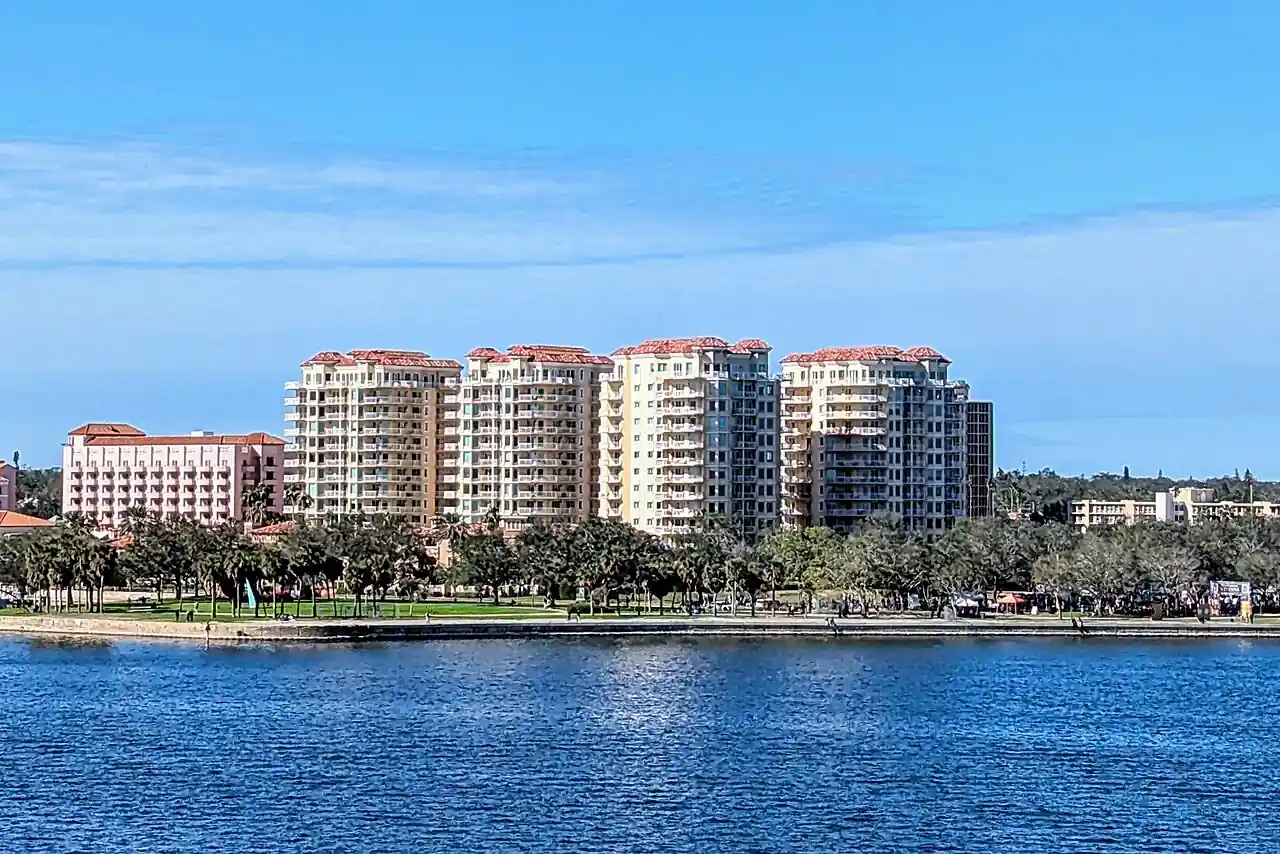
Vinoy Place condominium towers on the St. Petersburg waterfront, seen from the St. Pete Pier, Pinellas County. Photo: Tatiraju.rishabh, CC BY-SA 4.0, via Wikimedia Commons.
Building age in St. Petersburg decides what to ask the board
How old your building is shapes what to ask the board, and the board's answers shape your HO-6.
- Census median year built, city and county
- Age brings repair and replacement planning
- Ask for the study, the budget and any inspection report
The Census Bureau's survey puts the median year built for all housing units in St. Petersburg at 1969 (ACS 2020-2024 5-year estimate)1.
For Pinellas County as a whole, the same survey gives 19772.
A median covers houses, apartments and condos together, so it says nothing about your own building. It does tell you older stock is common, and older condo buildings tend to carry bigger repair agendas: roofs, pipes, balconies and concrete all age.
Go deeper: what a building's age does and does not tell a unit owner
Age is not condition. A well-kept building from decades ago can be in better shape than a newer one that deferred work. The paperwork tells you more than the date.
The papers to ask for:
- The most recent structural integrity reserve study, if the association must have one.
- The current budget, with its reserve lines.
- Any milestone or structural inspection report the building has had.
- Minutes that mention planned repairs or a special assessment.
Where insurance fits. An HO-6 responds to sudden, covered damage. Wear, age and planned repairs are upkeep, and most unit-owner forms leave them out. Check your policy.
SIRS reserves: why an older building shows up in your dues
Florida stops owners in an association that must have a SIRS from voting reserves down. In an aging building, you feel that in the budget.
- Reserves for study items stay in the budget
- They cannot be spent on something else
- A funding gap can turn into an assessment
The rule: for budgets adopted on or after Dec 31, 2024, owners in an association required to have a structural integrity reserve study (SIRS) cannot vote to fund zero or reduced reserves for the items the study covers, and those reserves cannot be used for other purposes3 (Fla. Stat. § 718.112(2)(f)2.b., 3.3).
When the study says components need money set aside, the board budgets it, and each owner pays a share through regular assessments.
Reserves are planned spending. Insurance is for sudden, covered losses. Budget for the first; insure for the second.
Go deeper: questions for the board and the one exception in the rule
The statute carves out a multicondominium that uses an alternative funding method approved by the state's condominium division. Ask whether that applies to your association.
- Is our association required to have a SIRS, and when was the latest one finished?
- Do the reserve lines in this year's budget match the study?
- If reserves are behind, how does the board plan to close the gap: a higher budget or a special assessment?
- Is any special assessment approved or under discussion? Buyers should ask before closing.
Money you pay toward reserves is not a covered loss, so your HO-6 generally does not reimburse it. The Florida condo insurance guide covers the reserve rule alongside the rest of the state's condo law.
Special assessments: set loss assessment coverage for your building
Owners face two kinds of assessment. Only the kind that follows a covered loss is something your policy may help pay.
- Repair and reserve assessments: yours to budget
- Assessments after a covered loss: insurable
- Florida sets a floor, not a target
The floor in Florida: a unit-owner policy must carry no less than $2,000 of property loss assessment coverage, a single limit for all assessments arising from the same direct loss, as long as the loss is a type your policy covers4 (Fla. Stat. § 627.714(1)4).
Two figures decide whether that floor is enough: the master policy's deductible and your ownership share. The master policy summary gives the first; your declaration gives the second. Try them below.
Loss assessment calculator
Math only. Enter the association's master-policy deductible and your share of the association (from the declaration). The result is what your share of that deductible would be, compared with the loss assessment limit you carry.
Whether your loss assessment coverage pays an assessment for the association's deductible depends on your policy form. Ask before you rely on it.
The loss assessment coverage guide walks through the math step by step.
Go deeper: when loss assessment coverage responds, and when it stays out
The test is the cause. If the association levies a special assessment because the community took a loss, for example wind damage to several roofs beyond the master policy's limits, loss assessment coverage may help; the assessment is covered when your own policy would cover that cause5.
A share of the association's deductible is a common way a storm loss reaches owners. Whether your form pays toward it varies, so ask each company before you rely on it.
An assessment to fix age or fund reserves is not a loss. Plan for it in your savings, not your policy.
Pinellas County storm records and the deductibles they touch
Wind is the usual path from a building loss to an owner's bill. Know both deductibles: yours and the association's.
- Official NCEI counts for the county
- Zone reports can list one storm more than once
- Choose a hurricane deductible you could pay
NCEI files tropical storm and hurricane reports by forecast zone, so a single storm can be counted more than once. The days figure is the steadier gauge of how often.
For an HO-6 owner, the link is money: the master policy's wind deductible is paid by the association, which can assess owners for it, while your own hurricane deductible applies to your unit's claim.
Go deeper: the hurricane deductible choices Florida insurers must offer
Before a personal lines residential policy is issued, Florida requires the insurer to offer a $500 hurricane deductible and deductibles of 2, 5 and 10 percent of the policy dwelling limits11, with exceptions written into the same statute (Fla. Stat. § 627.701(3)(a)11).
For a condo unit, the base is unclear: the statute speaks of "policy dwelling limits" and never defines that phrase for a condominium unit owner policy12. Ask whether your company applies the percentage to Coverage A alone or to A plus C.
The Florida page has a calculator that turns each option into dollars. Your declarations page shows the deductible that actually applies.
How much St. Petersburg housing sits in large buildings
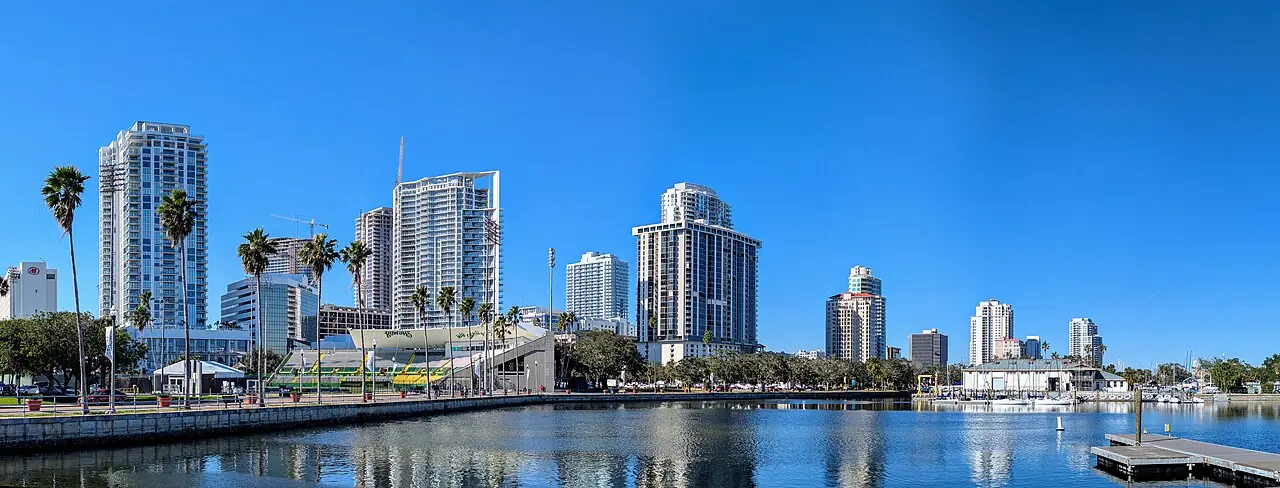
In a building with many units, the master policy and the declaration decide where the association stops and you start.
- Census counts by building size
- Big buildings run on one master policy
- Your declaration draws the line
In St. Petersburg, 18.3% of housing units are in structures with 20 or more units13, and 8.0% are in structures with 10 to 19 units14.
Across Pinellas County, 18.0% of housing units are in structures of 20 or more units15.
These shares include rental apartments, not only condos. For a condo owner in a larger building, the useful point is that one association policy insures the structure, and your HO-6 picks up what it leaves.
Go deeper: what a large building changes for your HO-6
- More neighbors, more shared plumbing. Water from another unit is a common claim in stacked buildings. Read the water wording in your policy.
- One master deductible, many owners. A building-wide deductible split across owners is where loss assessment coverage earns its place.
- Bigger boards, more paperwork. Ask the manager for the master policy certificate each year; limits and deductibles can change at renewal.
The water damage from the unit above guide covers the leak case.
Florida's condo act names the parts of your unit you insure
The statute lists what the master policy must skip. After a remodel or two, that list is worth more.
- Coverings, fixtures, appliances, cabinets
- Replacements and upgrades count too
- Your declaration settles the edges
Florida's act: the association's coverage leaves out personal property in the unit or its limited common elements, plus floor, wall and ceiling coverings, electrical fixtures, appliances, water heaters, water filters, built-in cabinets, countertops and window treatments inside the unit, including their replacements16 (Fla. Stat. § 718.111(11)(f)3.16).
Put simply, the owner of the unit is responsible for every item on that list and for any coverage on it17, as Fla. Stat. § 718.111(11)(f)3., (g)17 reads.
Go deeper: why remodels in an older condo raise your Coverage A
A unit in an older building may have been redone more than once. Every replacement cabinet, counter, floor and fixture on the statute's list is yours to insure at what it would cost to replace today.
Coverage A is the part of an HO-6 for permanently installed property in the unit that the association's policy does not already cover18. Price the list room by room, then add anything a past owner upgraded.
For the arithmetic of both limits, open how much condo insurance you need; for what each lettered part of the form does, read the HO-6 insurance explainer.
Declined elsewhere? Citizens may write your unit
When companies pass on a unit, Florida's residual market may take it. Check occupancy and value before you count on it.
- Written for owners who live in the unit
- A value ceiling covers dwelling plus contents
- Some counties get a higher ceiling
Citizens offers condominium unit owner coverage, an HO-6 and a wind-only HW-6, to owners who live in their units; it reaches certain interior features, personal property, extra living costs and liability, and stops short of the building exterior19.
Before applying, add up Coverage A and Coverage C. Once that combined replacement cost reaches $700,000, the unit falls outside Citizens, unless the county is one where the Office of Insurance Regulation has found competition lacking, in which case units below $1 million still qualify20 (Fla. Stat. § 627.351(6)(a)3.20).
Where Pinellas stands: the Office of Insurance Regulation's order in Case No. 165625-14, issued December 22, 2014, found too little competition only in Miami-Dade and Monroe Counties and made no finding for Pinellas; no later determination was found as of September 30, 202621. Ask before you count on the higher ceiling.
Go deeper: rented units, seasonal use and the value test
- If you rent the unit out or live there only part of the year, ask how Citizens treats that before relying on it.
- Add Coverage A and Coverage C together when you check the value limit.
- The HW-6 covers wind only, so it pairs with a policy for the other perils.
Check the building's records before you pick limits
Public records and the association's own papers show the building's age and what the board is planning to spend.
- Year built and parcel details
- The association's official filings
- Budget, reserve study and minutes
Parcel details. The Pinellas County Property Appraiser22 has an online property search23. Look up your unit for the year built and parcel record, then check that your policy describes the same unit.
The state's count. DBPR's County Summary Report (file dated 09/26/2026) lists 1,844 condominium projects in Pinellas24, with 100,498 units among them; by DBPR's own description, the report takes in only approved and recorded projects of 8 or more units25.
From the association, ask in writing for the declaration's insurance section, the master policy certificate, the current budget and the latest reserve study.
Go deeper: the state's condominium records and your own paperwork
DBPR's Division of Florida Condominiums, Timeshares, and Mobile Homes26 posts its condominium extracts, including a list of condominiums by county, on its public records page. Smaller buildings outside the report's scope may not appear in the summary count.
Your own declarations page shows what you carry now. Buying? The realtors and lenders checklist covers what a closing needs.
Compare HO-6 quotes for your St. Petersburg unit side by side
One company's quote shows one company's policy. Several, on identical limits, show you where they part ways.
- Same limits and deductibles on every quote
- Ask each company which discounts apply
- A quote binds nothing; you decide
Whether your building is a waterfront tower or a small garden complex, St. Petersburg condo owners are welcome to request quotes here; every request goes to an agent licensed to sell insurance in Florida.
Each comparison checks the three things older-building owners most often leave unreviewed: Coverage A against the statute's list, the loss assessment limit against the master deductible, and the hurricane deductible choice. Asking for a quote does not bind coverage.
Other Florida city pages: Miami, Fort Lauderdale, Tampa, Orlando. Statewide rules: condo insurance in Florida.
Go deeper: how a comparison runs from start to finish
- Start with whatever paperwork you have: the page from your current policy that lists limits, plus anything the association gave you about its own coverage.
- From those, the agent works out which items in your unit sit on your side of the statute and which the building policy keeps.
- Quotes from multiple carriers are then requested on matching limits and a matching hurricane deductible, so no company looks different just because it was asked a different question.
- The results come back in one table, discounts and credits included.
- Nothing changes unless you pick one.
St. Petersburg condo owner questions
Is HO-6 insurance mandatory for a condo owner in St. Petersburg, Florida?
Florida's act assigns the listed interior items, and insuring them, to you Fla. Stat. § 718.111(11)(f)3., (g)17, which is different from an order to buy. The practical requirement usually comes from two places: your lender and your association's declaration. Read the declaration's insurance section. With no policy, an assessment after a building loss and any damage inside your unit are paid out of pocket.
Why can a condo in an older building be harder to insure?
Companies weigh the building as well as the unit: its age, the state of its roof and plumbing, its wind exposure and how well the association is funded. Each company weighs these differently, which is why one decline does not mean every company will decline. Comparing several helps, and Citizens is the state's residual market when standard companies pass.
Will my HO-6 pay a special assessment for SIRS repairs or reserves?
Generally not. Reserve funding and planned structural repairs are upkeep, not a sudden covered loss, and loss assessment coverage responds to assessments that follow a covered loss. Florida requires at least $2,0004 of that coverage. Ask the board early about planned assessments so you can budget for them.
How do I find out what year my St. Petersburg condo building was built?
Search your unit on the Pinellas County Property Appraiser22 site, whose parcel records show the year built. The association's manager, the declaration and the reserve study are a second source. Knowing the age helps you ask the right questions about reserves, inspections and repair plans before you set your limits.
How can I find out about current or pending special assessments before buying a St. Petersburg condo?
Ask the seller and the association in writing whether any special assessment is approved, pending or under discussion, and read the last year of board minutes. Request the current budget and the latest structural integrity reserve study, if the association must have one; a gap between them hints at costs ahead. Loss assessment coverage helps only with assessments that follow a covered loss.
Can I avoid inspection-driven assessments by buying in a newer Pinellas County building?
A newer building may face fewer near-term repairs, but age alone does not settle it. If the association must have a SIRS, owners cannot vote to skip or cut reserves for the study's items3, whatever the building's age. Ask for the study and the budget, and confirm the year built on the Pinellas County Property Appraiser22 site.
Who can review a condo association's reserve study and financials before I buy?
Someone you hire who has no stake in the sale: an accountant for the budget and financial statements, an engineer for the study's physical findings, or a real estate attorney for the documents as a whole. On the insurance side, the master policy certificate and the declaration show what the association insures and what falls to your HO-6.
Does Citizens write HO-6 policies for Pinellas County condo owners?
Citizens offers an HO-6 and a wind-only HW-6 to owners who live in the unit. Under Fla. Stat. § 627.351(6)(a)3.27, the value ceiling is $700,000 of combined dwelling and contents replacement cost27. The higher county limit applied, per OIR's order in Case No. 165625-14 (December 22, 2014)21, only to Miami-Dade and Monroe, not Pinellas.
Before you renew, make one call.
A licensed agent compares several companies on the same limits. Asking changes nothing on your policy, and a quote never binds you.